In advanced manufacturing sectors such as automotive electronics, medical devices, and consumer electronics, precision injection-molded parts play a decisive role in product performance, reliability, and regulatory compliance. These components are no longer simple structural elements; they are functional interfaces that directly influence system stability, lifespan, and market competitiveness.
As product designs evolve toward miniaturization, higher integration, and tighter tolerances, injection molding must consistently deliver complex geometries, micron-level dimensional accuracy, and stable performance at scale. Achieving this balance requires a mature combination of tooling engineering, material science, and process control—rather than equipment alone.
Technical Foundations of Precision Injection-Molded Parts
The competitiveness of precision injection molding lies in its ability to unify high-volume efficiency with high-accuracy manufacturing. This capability is built on three interdependent technical foundations: equipment and tooling, process control, and material adaptation.
Equipment and Tooling as the Basis of Dimensional Accuracy
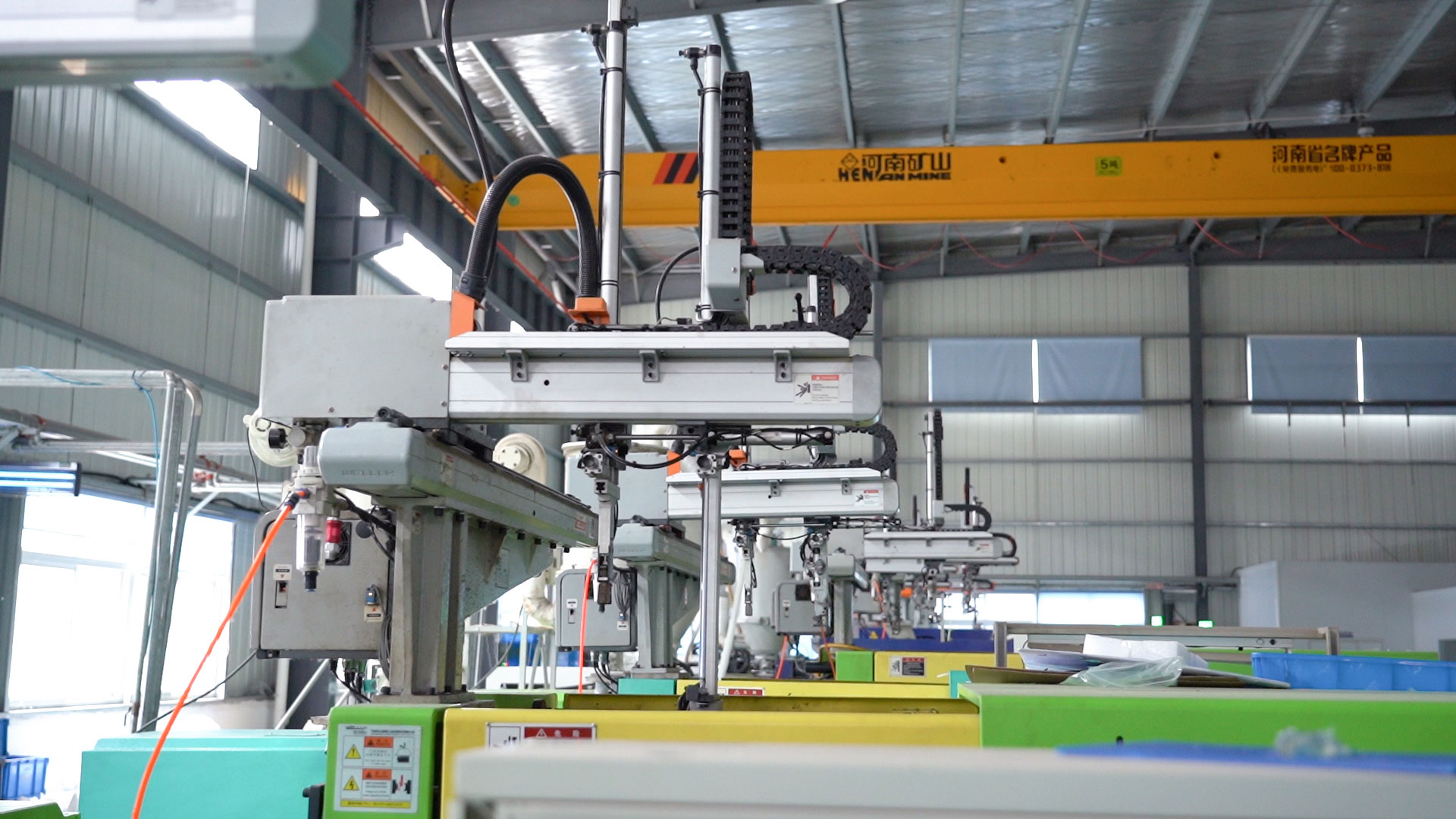
Precision injection molding depends on stable, high-performance injection machines operating within well-defined process windows. Clamping force stability, injection repeatability, and thermal control directly affect part consistency in high-volume production.
Equally critical is mold engineering. Mold cavities and cores must be manufactured within tightly controlled tolerances to prevent flash, deformation, or short shots. For demanding applications, mold steels such as S136 and H13 are commonly selected for their wear resistance, thermal stability, and polishability.
Advanced tooling solutions—such as hot runner systems and conformal cooling channels—are increasingly used to improve melt flow balance, cooling efficiency, and surface finish. These design choices are particularly important for optical components, medical parts, and thin-wall precision structures.
Process Control Across the Injection Molding Lifecycle
Process stability is achieved through precise control of each production stage, from raw material preparation to final inspection.
Hygroscopic materials such as PA and PC require controlled drying to reduce moisture-related defects such as silver streaks or internal voids. During molding, multi-stage pressure and holding strategies are applied to balance filling behavior, reduce weld lines, and minimize internal stress.
In high-precision production environments, statistical process control (SPC) is widely used. Continuous dimensional sampling and trend monitoring enable early detection of deviations, allowing manufacturers to maintain tolerances within micron-level ranges during long production runs.
Material Selection Based on Functional Requirements
Material choice directly determines the long-term performance of injection-molded parts. Precision molding frequently involves both general-purpose and engineering plastics, including PP, ABS, PC, PA, POM, and PEEK.
Different applications impose different priorities:
- Automotive functional components often require oil resistance and dimensional stability
- Medical products demand biocompatibility, sterilization compatibility, and low contamination risk
- Electronic components frequently require flame-retardant or anti-static properties
Effective material selection aligns mechanical performance, environmental resistance, and regulatory requirements with real-world operating conditions.
Cross-Industry Applications of Precision Injection-Molded Parts
With advancements in tooling and process control, precision injection-molded parts now support a wide range of high-value industries.
Automotive Manufacturing and New Energy Vehicles
In automotive platforms, injection-molded parts are widely used in sensors, actuators, motor assemblies, and electronic housings. These components must maintain dimensional stability under vibration, temperature variation, and chemical exposure.
As a result, automotive injection molding is typically governed by strict quality frameworks such as IATF 16949, emphasizing traceability, consistency, and risk prevention across the supply chain.
Consumer Electronics and Precision Assembly
Consumer electronics demand compact designs, tight assembly tolerances, and durability under frequent use. Precision injection molding supports connectors, housings, and micro-components where consistent fit and long-term mechanical integrity are essential.
In high-volume production, even minor dimensional variation can affect assembly yield and product lifespan, making process repeatability a key performance indicator.
Medical Devices and Healthcare Applications
Medical injection-molded parts are subject to some of the most stringent requirements in manufacturing. Beyond dimensional accuracy, material safety, cleanliness, and regulatory compliance are critical considerations.
Production commonly takes place in controlled environments, and mold designs are optimized to eliminate burrs, sharp edges, and particulate contamination—particularly for disposable medical products and patient-contact components.
Quality Assurance and Compliance in Precision Injection Molding
In precision injection molding, quality is established through systems and data rather than claims.
International management frameworks such as ISO 9001 and IATF 16949 are widely adopted to ensure traceability, standardized processes, and continuous improvement. These systems are supported by comprehensive inspection capabilities, including coordinate measuring machines (CMMs), mechanical testing, and environmental monitoring.
Increasingly, critical dimensions and quality metrics are tracked using digital records, enabling transparent performance evaluation across batches, programs, and production cycles.
Industry Outlook — Toward Intelligent and Sustainable Injection Molding
As manufacturing advances toward automation and sustainability, injection molding continues to evolve. Intelligent monitoring systems, data-driven process optimization, and energy-efficient equipment are becoming standard practices.
At the same time, environmental considerations—such as material efficiency, recyclability, and emission control—are influencing design and production decisions. In this environment, the future of precision injection molding will be defined by engineering depth, process intelligence, and quality discipline, rather than scale alone.